When we started toofus™ in 2024, we started it because we believe in the honour code of cost transparency.
This means that, as much as possible, we reveal all dental implant treatment costs from the start, what is included in that cost, what can cost more and why additional treatments may or may not be necessary.
We took it one step further by applying the same standard to the way our patient success coordinators responded to enquiries sent by patients like yourself.
At any of our toofus™ clinics, there is no need to come down for a consultation just to get a treatment plan and costs if you can give us as much information as possible about your oral health and desired outcome online.
We spend time running through options and treatment costs with patients online even before they decide to choose toofus™ Dental as their dental implant clinic.
Some of this information includes:
- Which tooth or teeth is/are missing
- How long the teeth have been missing
- Whether the teeth need to be extracted
- Whether you have bone loss/gum disease
- Whether you have had recent dental X-rays or 3D CBCT scans done
- Your medical conditions and long-term medications
- Your desired treatment outcome
- Any existing treatment plans or quotations
It is now 2026, and yet we speak to an increasing number of patients getting more confused and wary of dental clinics because of perceived transparency and affordability vs actual transparency and affordability.
In the spirit of patient education, we have written this guide to help you (even if you do not intend to be a patient with us) receive proper dental implant treatment without having to deal with hidden costs or unnecessary fee bulk-ups.
If you have a friend/family member who is looking for dental implants treatment, share this guide with them.
Together, we can make dental implants care more transparent and straightforward.
| Quick Summary |
|---|
| ▶ A complete dental implant usually includes the implant fixture, abutment and implant crown. ▶ Dental implant costs in Singapore vary depending on the treatment and additional procedures required. ▶ Bone grafts, sinus lifts, guided surgery and sedation are not automatically required for every dental implant. ▶ Dental implant brands and crown materials can affect cost, but a higher price does not always mean better results. ▶ An itemised dental implant quote should clearly state what is included and what may cost extra. |
Table of Contents
- What You Actually Need To Complete Dental Implant Treatment
- Average Dental Implant Cost in Singapore
- Does The Dental Implant Brand Really Matter?
- Does The Implant Crown Matter?
- Screw-Retained vs Cement-Retained Implant Crowns
- Front-Tooth vs Back-Tooth Dental Implant Costs
- Your Dental Implant Cost Checklist
- Our Final Advice
What You Actually Need To Complete Dental Implant Treatment
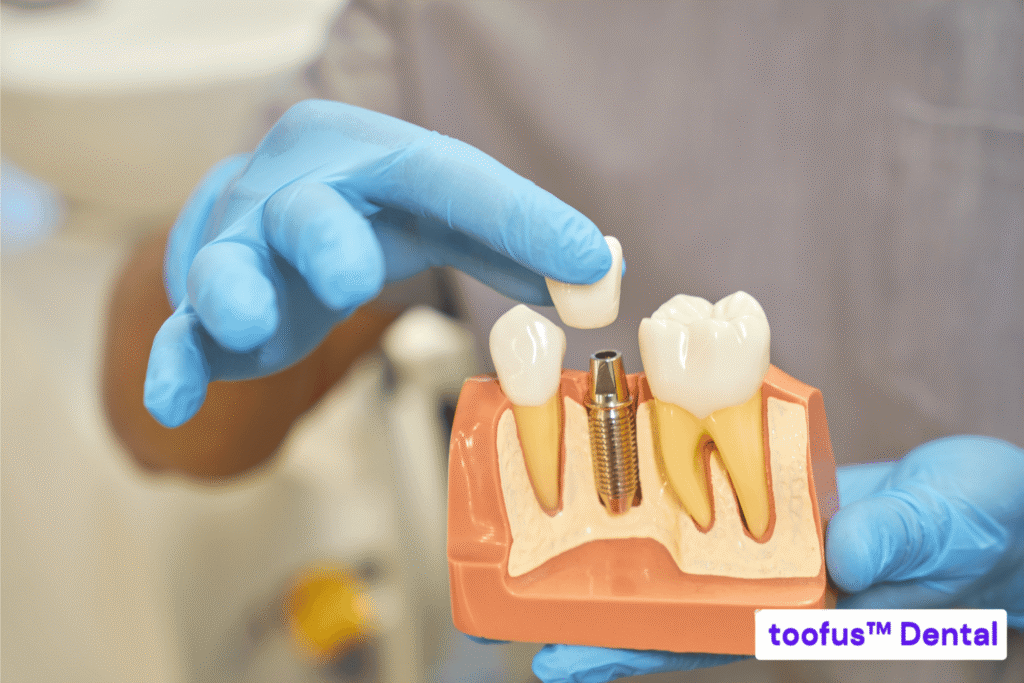
A completed single-tooth dental implant usually requires the following 3 principal components:
- The dental implant fixture
This is the screw-shaped component surgically inserted into the jawbone. It replaces the root of the missing tooth. - The abutment
The abutment connects the implant fixture to the implant crown. It may be a prefabricated or customised component. - The implant crown
This is the visible replacement tooth placed over the abutment or attached directly to the implant-abutment assembly.
A price advertised as a “dental implant” may refer only to the surgical placement of the fixture.
If the abutment and crown are excluded, you will not have a completed replacement tooth at the end of treatment.
Average Dental Implant Cost in Singapore
There is no single correct price for every dental implant because costs depend on:
- The number and location of missing teeth
- Whether the tooth still needs to be removed
- The amount and quality of available bone
- Whether gum disease is present
- Whether bone or gum grafting is required
- The implant system selected
- The type of abutment and crown
- Whether temporary teeth are requested
- Whether the surgery is straightforward or complex
- The clinician’s training and experience
- The laboratory and components used
- Whether GST is included
As an official reference, the Ministry of Health publishes average fees charged to private, non-subsidised patients at public healthcare institutions.
The published average for an implant with crown ranges from approximately $4,539 – $6,600 per unit, excluding GST and generally excluding consultation, X-rays, investigations and re-treatment fees. These are public-institution averages rather than mandatory private-clinic prices.
Based on publicly advertised private-clinic fees in Singapore, patients may encounter the following broad ranges:
| Price category | Indicative completed cost per tooth | What to check |
| Lower advertised range | Around $2,000 – $3,000 | Confirm whether the abutment, crown, CBCT, medication, reviews and GST are included |
| Mid-range | Around $3,000 – $5,000 | Confirm the implant brand used, crown material, grafting exclusions and temporary tooth costs |
| Higher or complex range | More than $5,000 | Check on implant brand components, specialist care, grafting or increased surgical complexity |
The cheapest quotation is not inappropriate or suspicious. Neither is the most expensive quotation better.
The question is whether the quotation accurately reflects what you need and whether you understand exactly what you will receive.
What You Actually Need To Complete Dental Implant Treatment
For a straightforward single-tooth implant, you will usually need:
- A clinical consultation and medical-history review
- Appropriate dental X-rays
- A CBCT scan when required for three-dimensional planning
- Assessment and stabilisation of active gum disease
- Extraction of the unsalvageable tooth, if it is still present
- Surgical placement of the implant fixture
- An abutment
- An implant crown
- Follow-up reviews
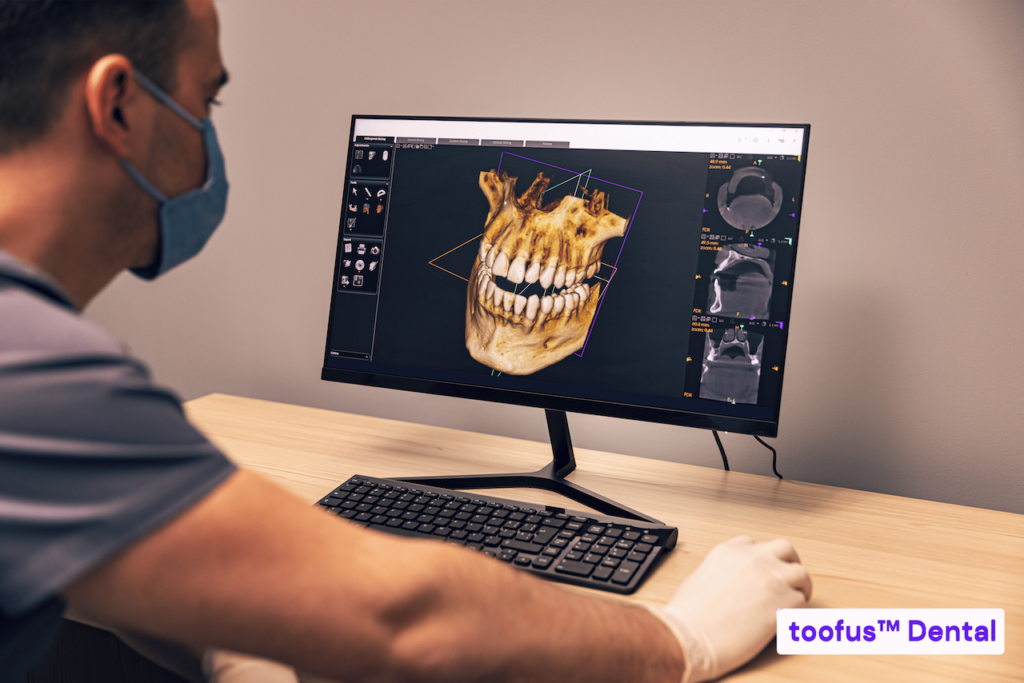
A thorough implant assessment considers your general health, oral health, bite, bone volume and bone quality. Additional grafting may be required when there is insufficient hard or soft tissue.
Depending on the case, treatment may also include:
- Bone grafting
- A barrier membrane
- Gum grafting
- Sinus-floor elevation
- Socket preservation
- A temporary tooth
- Guided implant surgery
- Sedation
- Treatment of infected or retained roots
- A night guard for patients who grind their teeth
These additional procedures should not just be added in. Each one should have a clinical reason behind it.
What You Do Not Automatically Need
You Do Not Automatically Need A Bone Graft
Bone grafting should be recommended when the available bone cannot support an implant in the correct position or when additional bone is needed for function, stability or aesthetics.
You should not be told that everyone receiving an implant requires a bone graft.
Ask your dentist:
- Where is the bone deficiency?
- Is the deficiency horizontal, vertical or both?
- Can you show it to me on my CBCT scan?
- Can the implant be placed safely without grafting?
- Is the graft being performed before or during implant placement?
- What material will be used?
- Is a membrane required?
- How will the graft change the treatment time and prognosis?
You Do Not Automatically Need A Sinus Lift
A sinus lift is relevant only to certain upper back-tooth implant sites where there is insufficient bone height beneath the maxillary sinus.
It is not relevant to lower-jaw implants or most front-tooth implant sites.
Sinus-floor elevation can be performed using different approaches depending on the remaining bone and the extent of augmentation required.
If a sinus lift is recommended, ask:
- How much bone height is currently available?
- What implant length and position are being planned?
- Is a transcrestal or lateral-window approach proposed?
- Can the implant be placed during the same surgery?
- What alternatives are available?
- What additional risks and healing time are involved?
You Do Not Automatically Need Guided Implant Surgery
Guided implant surgery uses digital planning and a surgical guide to help transfer the planned implant position to the mouth.
Evidence indicates that fully guided surgery can improve placement accuracy compared with freehand placement. However, this does not mean every straightforward implant requires a surgical guide.
Guided surgery may be particularly helpful when:
- Space is limited
- Several implants must be positioned together
- Important nerves or anatomical structures are nearby
- The available bone is narrow
- Immediate placement or loading is planned
- A full-arch prosthesis is being planned
- The restorative position needs very precise coordination
It should be discussed as a clinical planning method and not sold as an “upgrade.”
Also ask whether the guided-surgery fee includes:
- Digital implant planning
- CBCT-to-scan alignment
- Surgical-guide design
- Guide fabrication
- Guide sleeves and drilling components
- Any repeat scan or remake required
You Do Not Automatically Need Socket Preservation
Socket preservation involves placing grafting material into or around an extraction socket to reduce the amount of ridge shrinkage after a tooth is removed.
Research suggests that it can reduce post-extraction bone loss and may reduce the need for additional grafting later. However, it does not eliminate all bone changes or guarantee that no further graft will be required.
Socket preservation may be reasonable when:
- An implant is planned after the extraction site heals
- Maintaining the ridge contour is important
- The tooth is in the aesthetic zone
- The socket walls are damaged
- Significant ridge collapse is anticipated
- Immediate implant placement is unsuitable
It may be unnecessary when:
- No future implant is planned
- The implant can be placed immediately, and the site can be managed appropriately
- The expected benefit is limited
- Another staged augmentation plan is already required
It should not be performed merely because it is available. It should also not be described as something performed only when the patient independently requests it.
The dentist should explain its expected clinical benefit in your specific case.
You Do Not Automatically Need Sedation
Many implant surgeries can be completed under local anaesthesia.
Sedation may be considered for patients with:
- Severe dental anxiety
- Difficulty tolerating prolonged treatment
- Complex or extensive surgery
- Certain medical or behavioural considerations
If sedation is proposed, ask whether the fee includes:
- The sedation provider
- Medications
Does The Dental Implant Brand Really Matter?
Yes, but not in the simplistic way marketing sometimes suggests.
The implant brand is just one part of the overall treatment.
Other factors may be equally or more important, including:
- Proper diagnosis
- Implant positioning
- Available bone and gum tissue
- Surgical technique
- Implant stability
- The implant-abutment connection
- Crown design
- Bite forces
- Oral hygiene
- Smoking
- Diabetes control
- History of gum disease
- Long-term maintenance
A “premium” implant cannot compensate for poor planning, an unstable bite or untreated gum disease.
Likewise, a sensibly priced implant from a properly regulated and well-supported system should not be assumed to be inferior merely because it costs less.
What Should You Check About The Implant Brand?
Ask the clinic:
- What is the exact implant manufacturer and system?
- Is the implant registered for supply in Singapore?
- How long has the system been in clinical use?
- Is there published clinical evidence for that specific system?
- Are replacement components readily available?
- Can another clinic obtain compatible components if I relocate?
- Does the clinic stock original components?
- What happens if the manufacturer discontinues the system?
- Is there a price difference between the available brands?
Medical devices supplied in Singapore are regulated by the Health Sciences Authority, and patients can search the Singapore Medical Device Register where appropriate.
Common Implant Brands You May Hear About
Straumann
Straumann is a well-established Swiss implant company with an extensive range of implant and restorative components.
Patients may choose it because of:
- Extensive clinical documentation
- A broad restorative ecosystem
- International availability
- Different implant materials and surface options
- Component availability for complex restorative cases
It is commonly priced higher than regular implants. However, this does not guarantee that an implant will integrate or remain complication-free.
Some lines that are owned by Straumann include Neodent and Anthogyr.
Megagen
Megagen is a Korean dental implant system that is often used for Asian jaws. It is an established international system that has product lines for single implants, full-arch rehabilitation and digitally planned implant treatment.
Its potential advantages include:
- A long clinical history
- Broad restorative options
- Full-arch treatment solutions
- International component support
Nobel Biocare
Nobel Biocare is another established international system.
Osstem
Osstem is a widely used South Korean implant system that is frequently positioned as a more affordable alternative to some European or American premium systems.
Its lower price does not automatically mean it is unsuitable.
Dentium
Dentium is another South Korean implant system used in Singapore and internationally.
Our Honest View On Implant Brands
A more expensive brand may be worthwhile when its specific design, material, surface, dimensions or restorative options solve a genuine clinical problem.
However, you should not be pressured into paying for a “premium implant” without being told:
- What the premium brand changes in your case
- Whether it improves the treatment plan
- Whether the alternative brand is clinically unsuitable
- Whether only the implant fixture changes or the abutment and crown also change
- Exactly how much more you are paying
The best implant brand is not necessarily the most expensive one.
It is the implant system that allows your dentist to provide a safe, restorable and maintainable result for your specific anatomy and treatment goals.
Does The Implant Crown Matter?
Yes.
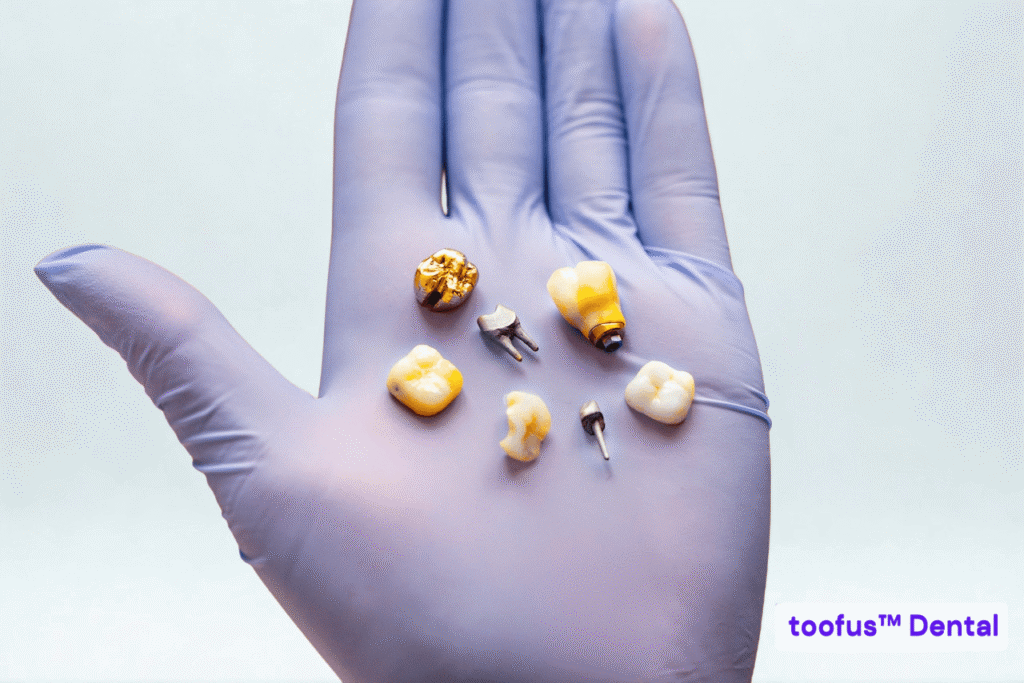
Patients sometimes focus heavily on the implant fixture while treating the crown as an afterthought. However, the crown is the part you see, bite on and clean around every day.
An implant crown must be designed to:
- Fit accurately
- Support an appropriate bite
- Allow cleaning around the implant
- Avoid excessive force on the implant
- Match the neighbouring teeth where aesthetics matter
- Maintain appropriate contact with adjacent teeth
- Support the surrounding gum shape
The crown fee may include several separate components:
- Implant impression or 3D intraoral scan
- Impression coping or scan body
- Abutment
- Custom abutment, if required
- Laboratory work
- Crown material
- Laboratory implant components
- Crown insertion
- Screw and torque procedure
- X-ray confirmation
- Bite adjustment
- Review
Ask whether the quoted “crown price” includes the abutment. Many patients assume it does when it may be charged separately.
Metal Implant Crown
A full-metal crown is strong and requires less restorative space, but it has a metallic appearance.
It may occasionally be considered for a back tooth where aesthetics are unimportant, and space is limited. However, it is much less commonly requested today.
Ask what metal alloy is being used and whether the abutment is included.
Porcelain-Fused-To-Metal Crown
A porcelain-fused-to-metal, or PFM, crown has a metal framework covered with tooth-coloured porcelain.
Potential advantages include:
- A long history of clinical use
- Good structural strength
- Familiarity among laboratories and clinicians
Potential limitations include:
- Porcelain chipping
- A more opaque appearance that is not aesthetic
- Possible visibility of a darker margin if the gums recede
- Different aesthetic qualities compared with some all-ceramic materials
Zirconia Implant Crown
Zirconia is widely used for implant crowns because it can provide strength, suitable aesthetics and a metal-free, visible crown material.
Monolithic zirconia may be useful in areas exposed to higher biting forces because the crown is milled predominantly from one material rather than relying on a thick porcelain veneer.
However, “zirconia” is not a single uniform product. Different zirconia formulations vary in:
- Strength
- Translucency
- Layering
- Surface finish
- Manufacturing method
Ask whether the crown is monolithic, layered or cut-back and veneered.
e.max or Lithium-Disilicate Crown
e.max is a brand of lithium-disilicate ceramic commonly selected for its optical and aesthetic qualities.
It may be considered for:
- Front teeth
- Premolars
- Cases where translucency and shade matching are important
- Selected implant crowns with appropriate design and restorative space
It is not automatically the best material for every implant crown, particularly in cases involving heavy biting forces, limited thickness, severe grinding or long-span implant restorations.
Current research reports favourable short- and medium-term survival for implant-supported lithium-disilicate single crowns, but material selection should remain case-specific.
Screw-Retained vs Cement-Retained Implant Crowns
This is a frequently overlooked part of an implant quotation.
Screw-Retained Crown
A screw-retained crown is attached directly to the implant or abutment with a screw.
Potential advantages include:
- Easier retrieval for repair or maintenance
- No risk of excess cement being left beneath the gum
- Easier access to the implant components
Potential disadvantages include:
- A screw-access opening is required
- The planned implant position must allow the access opening to emerge appropriately
- Aesthetic management may be more challenging in selected front-tooth cases
Cement-Retained Crown
A cement-retained crown is cemented over an abutment.
Potential advantages include:
- No visible screw-access opening
- Greater flexibility when the implant angulation is not ideal
Potential disadvantages include:
- Excess cement may be difficult to detect
- Retrieval can be more difficult
- The crown or abutment may need to be replaced if removal is unsuccessful
Ask which design is proposed and why.
Front-Tooth vs Back-Tooth Dental Implant Costs
A front-tooth implant is not automatically cheaper because the tooth is smaller.
In fact, front-tooth implants may be more technically demanding because the result must match:
- Tooth colour
- Tooth shape
- Gum height
- Gum thickness
- Smile line
- Adjacent tooth proportions
- The emergence of the crown from the gum
A front-tooth implant may require:
- A temporary tooth
- Customised gum shaping
- A custom abutment
- Higher-aesthetic ceramic work
- Gum grafting
- Bone contour grafting
- Additional laboratory stages
A back-tooth implant may involve different challenges, including:
- Greater biting forces
- Limited mouth opening
- Reduced restorative height
- Proximity to the maxillary sinus
- Proximity to the lower-jaw nerve
- The need for a wider or stronger restoration
- Grinding or clenching forces
Therefore, front and back implant prices should not be compared solely by tooth size.
Ask what clinical or laboratory factor causes any difference in price.
Your Dental Implant Cost Checklist
Please take note that any item with an asterisk at the front is necessary to complete the dental implant treatment and restore your teeth.
| Item | Included (Yes/No) | If Not, How Much? |
| Diagnostics and Assessment | ||
| *Consultation and Implant Assessment | ||
| *X-rays (OPG) | ||
| *CBCT 3D Scans | ||
| Preparatory Work | ||
| Gum Disease Treatment (only when needed) | ||
| Gum Grafting (only when needed) | ||
| Tooth Extractions (only when needed) | ||
| Socket Preservation (only if requested by you) | ||
| Retained Roots Removal (only when needed) | ||
| Guided (Keyhole) Surgery (only if requested by you) | ||
| Sinus Lift Surgery (only when needed for upper implant placement) | ||
| Surgery | ||
| Bone Graft (only when needed) | ||
| Bone Graft + Membrane (only when needed) | ||
| *Implant Surgery + Type of Implant Used | ||
| Interim (Choose One) | ||
| Dental Implant Temp Crown (only if requested by you) | ||
| Dentures (only if requested by you) | ||
| Implant Crown (Choose One) | ||
| *Metal Crown | ||
| *PFM Crown | ||
| *Zirconia Crown | ||
| *e-Max Ceramic Crown (more suitable for front teeth) | ||
| Follow-up and Reviews | ||
| *3D Intraoral Scans for Implant Crown | ||
| *Reviews | ||
| *Emergency Visits (if necessary) | ||
| Sedation (Choose One) | ||
| Oral Sedation | ||
| IV Sedation | ||
| GA Sedation | ||
Our Final Advice
Do not choose a dental implant clinic just based on the cost shown.
To avoid disappointment and bill shocks, choose a clinic based on whether they are willing to show you:
- What you need
- What you do not need
- Why each procedure has been recommended
- What each stage costs
- What Medisave can and cannot cover
- What may cause the final cost to change
- What happens if complications occur
- How the implant will be maintained in the long term
Cost transparency does not mean promising that every patient will pay the same amount. It means giving you enough information to understand the likely total cost before treatment starts, and obtaining your agreement before performing anything that materially changes that cost.
At toofus™ Dental, we are happy to discuss your possible treatment options and indicative costs online when sufficient information is available.
After your clinical examination and imaging, we will confirm which procedures are necessary and provide an itemised treatment plan before treatment begins.
You should never have to undergo implant surgery before discovering what it will cost to complete your tooth.