Losing a tooth and having to head to a dental clinic can be a scary experience. There is honestly nothing fun about going to a dental clinic. This is coming directly from a dentist.
This mini guide has been written to help new patients like yourself understand our toofus™ dental implants consultation process better. Through this guide, we aim to reduce fear, discomfort and any apprehension you might have about the process.
| Quick Summary |
|---|
| ▶ A dental implant consultation assesses your oral health, medical history and treatment goals. ▶ Dental X-rays help assess your jawbone, missing teeth and suitability for dental implants. ▶ Your dentist will discuss suitable treatment options, expected timelines and treatment costs. ▶ Further tests such as a CBCT scan may be required before dental implant treatment. ▶ You do not need to decide on dental implant treatment during your first consultation. |
Table of Contents
- Pre-Consultation
- Arriving at toofus™ Dental
- Dental Implant Consultation and Assessment
- Post Consultation
- If You Wish To Proceed With Treatment
Pre-Consultation
Our patient success coordinators undergo rigorous training to help patients like yourself get the treatment information you require before you enter any of our clinics.
While they are not dentists, they are trained by dentists to read X-rays, come up with tentative treatment plans and provide the preliminary costs you require for treatment. The reason why they have been trained in this manner is that we believe that information/knowledge is power.
We wish to empower our patients to understand their options and treatment alternatives based on their unique dental conditions before they enter a dental clinic. We also believe that providing transparency in our costs can help you make better treatment and budgetary decisions.
We try our best to keep our costs as simple and transparent as possible so that there is minimal frustration with costs.
Treatment fees that are quoted over our online channels are based on your description of your current oral health condition.
Our patient success coordinators provide clinically sound treatment plans and financial advice that are about 85-90% accurate to what you would typically receive at a dental clinic.
These are some of the usual questions our patient success coordinators might ask to help better determine the extent and scope of work that needs to be done:
- How many teeth are missing?
- Are they missing from the upper, lower or both?
- Are the remaining teeth shaky?
- Are you currently on dentures?
- Are you looking to restore your teeth because of aesthetics or because you are unable to eat?
When X-rays and photos are provided, we are able to more precisely identify the necessary treatment options/alternatives you can have. Where necessary, patients are also able to speak to dentists directly on the phone.
Common questions that patients ask us about dental implants at our clinic
- What is the difference between your implants and other implants?
- Do I need to have a bone graft?
- What is the difference between metal, PFM, zirconia and porcelain crowns?
- Can you do the implant on the same day?
- Can I still do implants if I am diabetic/am in cancer remission?
- Is there a big difference between Korean implants vs Swiss implants?
- Do I need to pay for the consultation if I am not ready to proceed with treatment?
- Are there any other costs I should be aware of that are related to my dental implant procedure?
All information that is discussed is then placed onto your appointment notes. This prevents you from having to repeat yourself. We understand that repeating yourself multiple times can be frustrating, especially when you have visited multiple dental clinics.
Once you have made a decision to visit us for a consultation, we will then book you in for your first consultation.
Second opinion consultations
At toofus™ Dental, we do not charge for second opinion consultations. Should you require a second opinion on your current oral condition and next steps, we are more than happy to schedule you in for a consultation.
Treatment costs
If you are looking to explore our treatment options and costs but are not ready to book an appointment, you can review our transparent fees or drop an enquiry with one of our patient success coordinators. We are also a CHAS and Medisave accredited clinic.
Our dentists
All toofus™ dentists are MOH-registered and have at least 6 years of experience placing dental implants. Our dentists also have advanced training in sinus lifts, gum grafting, ridge augmentation and complex oral surgery.
As a surgery-focused clinic group, our dentists work on implant surgery every day, so you are in good hands.
Arriving at toofus™ Dental
When you arrive at toofus™ Dental, you will be greeted by one of our patient success coordinators on a screen.
These coordinators work for our clinics remotely and are thoroughly trained to provide care to you during your patient journey with us.
You will check in via a SingPass QR code at our dental clinic. If you are a foreigner without SingPass, our patient success coordinators will help register you in the medical records system.
Each registration form requires the following key information, as it acts as a medical record between the clinic and you:
- Full registered legal name
- Date of birth
- Your NRIC/FIN/Passport details
- Medical history (if any)
- Medication allergies (if any)
- An emergency contact
Amongst other required information.
Dental Implant Consultation and Assessment
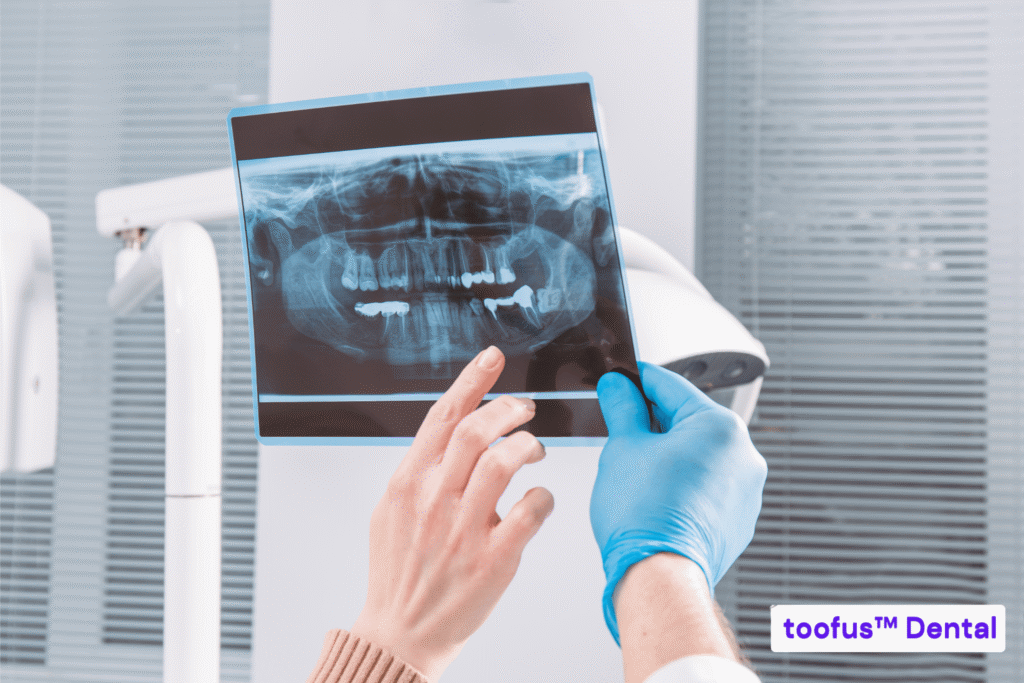
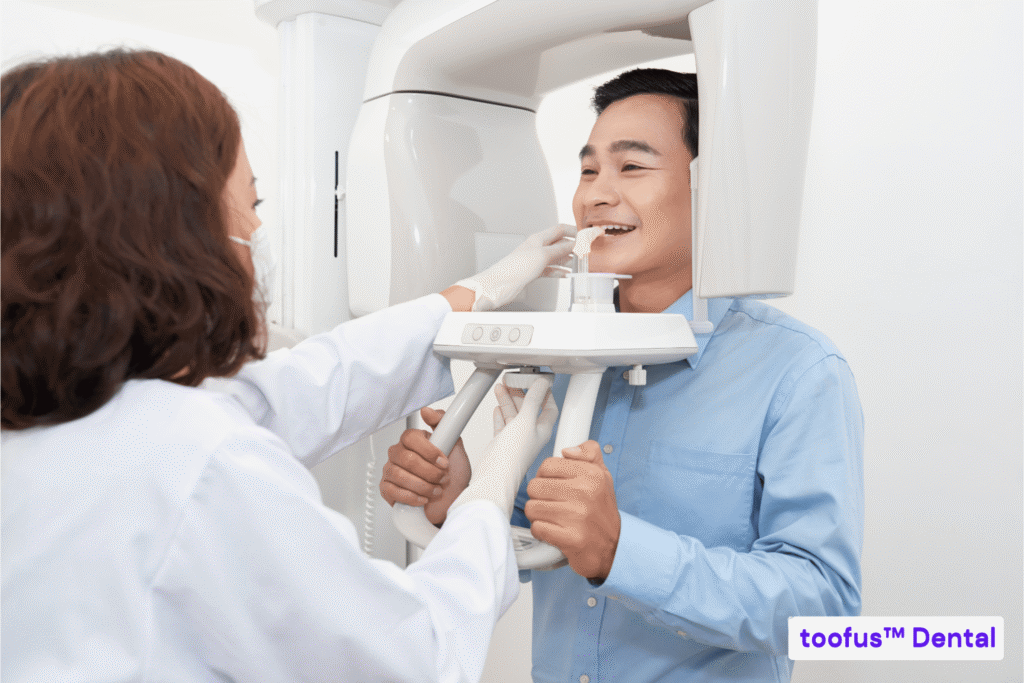
Before the consultation with one of our dental implant dentists, you will be asked to have your X-rays (OPG) taken. If you have had an X-ray taken in the last 6 months and do not wish to take X-rays again, do let us know so that we can help accommodate.
For all patients who wish to find out more about dental implants and their suitability for dental implants, it is necessary to take X-rays. If you have concerns about radiation from X-rays, there is nothing to worry about!
Radiation from X-rays is significantly less than taking a short-haul flight from Singapore to Kuala Lumpur. You are also given additional protection from radiation through a lead jacket and collar when taking your dental X-rays.
We do not charge for X-rays taken at our clinic for our consultations, as we believe that X-rays help our dentist have a clearer idea of your current and underlying oral health. It is an indispensable part of the consultation process, as it helps us (the dentists) be more informed about:
- The approximate bone depth in your jaw
- Whether there are any bone defects around teeth
- Missing teeth position
- Whether we can save your tooth if it has not been extracted
- Edentulous areas
- Whether you have existing restorations or implants
- Rough implant angulation
- Whether there are retained roots
- Whether there are any limitations or complications
- The approximate location of the maxillary sinuses and mandibular nerve canals
Once your X-rays have been taken, you will then proceed to a consultation with our dental implant dentists.
During the consultation, our dentists will do an oral assessment at the dental chair and review the following:
- Your desired treatment outcome
- Understand your past and current medical history as well as medications
- Work with your lifestyle and schedule to help see what treatments might work best for you
- Explain your current oral health
- Run through possible treatment plans, treatment durations and treatment costs.
A case study example would be something like the following:
Mdm Lim (63 years old) has worn full upper and lower dentures for 10 years. Her existing dentures have become loose and repeatedly cause sore areas along her gums. As a result, she finds it difficult to eat some of her favourite foods or chew harder foods properly. She initially visited toofus™ Dental to replace her existing dentures with a new set that would fit her gums more comfortably.
Mdm Lim had previously considered dental implants but was worried about the pain she assumed dental implant surgery would cause. She was also concerned that she might be too old for dental implants. Her diabetes was currently controlled, but she also had high blood pressure and was taking long-term medication for it.
During the consultation, our dental implant dentist first reviewed Mdm Lim’s medical history, current medications and most recent blood test results. She was asked about her latest HbA1c reading, blood pressure control and whether she had experienced any recent changes to her health.
Our dentist explained that being 63 years old would not automatically prevent her from receiving dental implants. Her overall health, ability to heal, bone condition, oral hygiene and control of her diabetes and blood pressure were more important considerations than her age alone. However, medical clearance or updated blood test results might be required before any surgical treatment could be confirmed.
An oral examination was then performed. Our dentist examined the areas where the dentures were rubbing against her gums, assessed the fit and stability of her existing dentures, and checked the amount and shape of the remaining gum and underlying bone.
Her OPG showed that the bone supporting her dentures had receded after approximately 10 years without natural teeth. This helped explain why her dentures had become progressively less stable. When teeth are removed, the jawbone no longer receives the same stimulation from chewing and may gradually reduce in height and volume.
The OPG also suggested that the available bone beneath her upper maxillary sinuses might be limited. Our dentist explained that the OPG could only provide an initial two-dimensional overview. A three-dimensional CBCT scan would be required if Mdm Lim wished to explore implant treatment, as this would allow the dentist to assess the exact bone height and width, the position of important anatomical structures and whether a sinus lift was actually necessary.
Based on the initial assessment, Mdm Lim was given two broad treatment options.
Option A: New Full Upper and Lower Dentures
The first option was to replace her existing dentures with a new set of conventional full upper and lower dentures.
Our dentist explained that the new dentures would be designed around the current shape of her gums. This could improve their fit, comfort, appearance and bite compared with continuing to wear her existing dentures. The sore areas caused by the old dentures would also be treated before or during the process of making the new set.
However, Mdm Lim was advised that conventional dentures rest entirely on the gums and underlying bone. Because she had already experienced considerable bone recession, the lower denture might still move during chewing or speaking even if it were made correctly.
The new dentures could improve her current situation, but they would not function exactly like natural teeth. She might still need to avoid certain hard, sticky or difficult-to-chew foods. Adjustments might also be required after placement as her mouth adapted to the new dentures.
Our dentist also explained that her jawbone could continue to change over time. The dentures might eventually require relining, adjustment or replacement as the shape of her gums continued to change.
Option B: Upper and Lower Implant-Supported Dentures
The second option was to use dental implants to help retain the upper and lower dentures.
Our dentist explained that implant-supported dentures remain removable, but they attach to implants placed within the jaw. The implants could provide greater stability and reduce the amount of movement Mdm Lim experienced when speaking and chewing.
Depending on the findings of the CBCT scan, a typical treatment plan might involve placing implants in the upper and lower jaws. The final number, position and type of implants could only be confirmed after assessing the available bone and designing the prosthetic treatment plan.
Because the initial OPG suggested limited bone height in parts of her upper jaw, a sinus lift might be required before or at the time of upper implant placement. Our dentist explained that the purpose of a sinus lift would be to create sufficient bone support for implants in the back of the upper jaw. It would not necessarily be required for every implant or every patient, and the need for it could only be confirmed after three-dimensional assessment.
Mdm Lim was also advised that implant-supported dentures would involve surgery and a healing period. The implants would need time to integrate with the jawbone before supporting the final dentures. Her existing dentures might need to be adjusted or temporarily relined while the implants healed.
Addressing Mdm Lim’s Fear of Pain
Mdm Lim then asked whether implant surgery would be painful.
Our dentist explained that implant surgery is normally performed under local anaesthesia. She should not feel sharp pain during the procedure, although she might feel pressure, vibration or movement. Some swelling, bruising and soreness could occur after the anaesthetic wore off, particularly if bone grafting or a sinus lift were required.
Her comfort options, post-operative medication and recovery expectations would be discussed before surgery. Sedation could also be considered if her dental anxiety was significant and if it was medically appropriate for her.
However, our dentist did not tell Mdm Lim that the procedure would be completely painless. Every patient heals differently, and a sinus lift or more extensive implant surgery may involve greater post-operative discomfort than straightforward implant placement.
Considering Her Diabetes and High Blood Pressure
Our dentist explained that controlled diabetes and high blood pressure would not automatically exclude Mdm Lim from implant treatment. Nevertheless, both conditions had to be assessed carefully because they could affect surgical safety, healing and the risk of infection or implant complications.
Before proceeding, Mdm Lim might be asked to provide:
- Her latest HbA1c or diabetes-monitoring results
- Recent blood-pressure readings
- A complete list of medications and supplements
- Information from her regular doctor
- Medical clearance, if clinically necessary
She was specifically advised not to stop or change any prescribed medication unless instructed to do so by the doctor responsible for managing her condition.
If her diabetes or blood pressure were not sufficiently controlled, implant surgery might need to be postponed until her medical condition had been reviewed and stabilised.
Reaching a Decision Together
After discussing both options, our dentist compared them according to Mdm Lim’s priorities.
Mdm Lim wanted to eat more comfortably, but she was anxious about surgery and did not want to rush into an extensive treatment plan. She was therefore given a written summary of both options, their expected stages and their estimated costs.
She was informed that choosing new conventional dentures would be the less invasive route and could still improve her comfort. However, the amount of improvement in stability—particularly for the lower denture—could be limited by the amount of remaining jawbone.
Implant-supported dentures could provide greater retention and chewing stability, but they would require further investigations, surgery, healing time, a higher financial commitment and ongoing implant maintenance.
Mdm Lim was not asked to make an immediate decision. She decided to first take the proposed treatment plan home and discuss it with her family. If she wished to explore implant-supported dentures further, her next step would be a CBCT scan and, where necessary, medical clearance from her doctor.
If she preferred to avoid surgery, the clinic could proceed with treating the sore areas and planning a new set of conventional full dentures.
The purpose of the consultation was not to persuade Mdm Lim to choose the more extensive treatment. It was to help her understand why her existing dentures had become loose, what could realistically be improved and which option best matched her health, priorities, comfort level and budget.
Post Consultation

There is no need to make an immediate decision post-consultation. This is especially so if your treatment plan is relatively extensive due to complex medical conditions or dental conditions.
Many patients that we see suffer from extensive tooth loss due to medications taken for chronic/hormonal health conditions. A large percentage of our patients have diabetes, hypertension, and high cholesterol. We also see patients who have immunocompromised systems.
The biggest draw for patients visiting toofus™ Dental is our vast experience and data working with medically compromised patients.
We do not just see patients for extensive and complex dental work once every 3 – 12 months. We see and work with them every single day.
We are equipped clinically and technologically to work with patients who require more complex or advanced dental treatments.
Because of our common patient base, we have developed treatment protocols that combine medical and medication safeguards to help our patients have a more comfortable patient journey. We also offer sedation for patients with dental anxiety, special needs, or who require additional relaxation during long dental procedures.
Should you need further time to think about your treatment plan or discuss it with a partner/spouse/relative, do not feel pressured to rush into treatment with us. Our dentists are guides, and not salesmen. The final decision to take treatment rests in your hands. You should only proceed with treatment with us if you feel comfortable and ready to undertake treatment.
We are here simply to guide you based on your current oral health/systemic health.
Your dental implant dentist will send you off with a treatment plan that includes treatment costs.
If You Wish To Proceed With Treatment
Should you be ready to proceed with treatment, you will be booked in for your next appointment.
Depending on your dental condition, your next appointment might either be the dental implant surgery or gum disease treatment or extractions. Each next step varies from patient to patient based on their oral health/oral condition.
Your treatment plan will follow the cost and patient journey as outlined by your dental implant dentist. There will be no sudden mysterious costs or additional/hidden fees once you commence treatment.
Your first dental implant consultation is an opportunity for you to understand your current oral health, explore the treatment options available and receive a clearer idea of the likely costs, duration and steps involved.
At toofus™ Dental, we believe that you should never feel rushed into making a healthcare decision. Dental implant treatment can involve surgery, several appointments and a meaningful financial commitment. You should therefore have sufficient time to ask questions, compare your options and discuss the treatment plan with the people important to you.
Our role is to provide you with the clinical information required to make an informed decision. Where appropriate, we will also explain non-implant alternatives such as dentures, dental bridges or retaining your existing teeth. Dental implants may be suitable for many patients, but they are not necessarily the only, or best, solution for every person.
If you decide to proceed, your appointments will follow the treatment journey and estimated costs explained by your dental implant dentist. If additional investigations, medical clearance or changes to the proposed treatment become necessary, these will be discussed with you before proceeding.
Most importantly, you should leave your first consultation understanding:
- Your current oral and bone condition
- Whether your remaining teeth can be retained
- The treatment options available to you
- The benefits, limitations and risks of each option
- The expected treatment duration and number of appointments
- The estimated costs, MediSave eligibility and likely out-of-pocket payment
- What will happen at your next appointment
Come prepared with your questions, medical history, and any previous dental records or X-rays you may have. We will guide you through the available options so that you can decide what feels medically, practically and financially appropriate for you.