If you are considering All-on-x (otherwise known as All-on-4 or All-on-6) dental implants, one of your immediate concerns might be whether they are painful. The straight answer is no; you will not feel anything during the All-on-x dental implant surgery.
The implant placement itself happens under local anaesthesia. Whatever is cutting through your gums or drilling through your jawbone will simply be felt as pressure and some vibration. It will not be painful.
Post-surgery, when the local anaesthesia wears off, there will be slight discomfort. However, you will be given pain medications to relieve the discomfort.
| Quick Summary |
|---|
| ▶ All-on-X dental implant surgery should not be painful because the treatment area is numbed with local anaesthesia. ▶ You may feel pressure, tugging or vibration during All-on-X dental implant placement, but not pain. ▶ Soreness and swelling are normal after surgery and are usually most noticeable during the first few days. ▶ Sedation options may be available for patients who experience dental anxiety or are undergoing more complex treatment. ▶ Pain that becomes worse after several days or is accompanied by signs of infection should be assessed by your dentist. |
Table of Contents
- Are All-on-X Dental Implants Painful?
- Why Is the All-on-X Dental Implants Procedure Not Painful?
- How Is a Typical All-on-X Procedure Done?
- What Sedation Options Are Available in Singapore?
- How Can You Reduce Discomfort After Surgery?
- Upper Arch vs Lower Arch Implants: Which Hurts More?
- Further Questions About Dental Implant Surgery Discomfort
Are All-on-X Dental Implants Painful?
No, there is no pain during the procedure. Post-procedure, just like any other dental procedure, there will be some discomfort.
If you do not have a high pain tolerance, you might feel a slight biting discomfort in the areas where the implant surgery was done.
Do take note that the procedure and the recovery are two completely different experiences.
If you are afraid of pain or require a more tender approach towards your implant surgery, do let your dental implant dentist or our patient success team know.
We are able to help customise your patient journey experience based on what you prefer.
During surgery
Patients who are worried about pain during the surgery do not have to. There is no pain during the implant surgery.
Your implant dentist will numb the surgical site with local anaesthesia. If you have opted for stronger sedation like IV sedation, you will be in a deep sleep during the procedure.
Patients who undergo implant surgery feel pressure, tugging and vibrations from the low hum of the implant drill through bone. It is a strange sensation but does not cause pain.
This discomfort-free experience is backed by a clinical review of full-arch procedures. During the clinical review, dozens of immediate implants were placed with no reports of intraoperative pain.
First 4 to 48 hours after surgery
This is when your local anaesthesia begins wearing off. You can expect a dull and throbbing ache in the jaw and gums where your implants have been placed.
Many patients report that it feels the same as when they have had a tooth extraction.
Swelling usually appears during this window too. Prescription painkillers or over-the-counter options like ibuprofen typically keep things in check.
A study tracking patient perception of recovery found pain and analgesic use peaked tightly around the 2.5 to 3 day mark, which lines up with what most patients report anecdotally.
Days 3 to 7 recovery
Swelling usually gets the worst around day two or three, then gets better after.
By day four or five, most patients would have stopped needing strong pain medication altogether, switching to just over-the-counter medications like paracetamol.
Soreness might linger, especially around the gum line. If you are wearing a “teeth in a day” prosthesis or an immediate denture, there might be tenderness and persistent soreness.
Why Is the All-on-X Dental Implants Procedure Not Painful?
The procedure is not painful because of the local anaesthetic or sedation method that is used during your procedure. Under local anaesthetic or sedation, your nerves are simply not transmitting any pain signals.
Local Anesthesia
Lidocaine or a similar painkilling agent gets injected directly around the surgical area, blocking nerve conduction around the jaw and gums for the duration of the procedure.
You stay awake and aware, but the tissue being worked on is completely numb.
Dentists also target specific nerve pathways in the jaw depending on where implants are going. The inferior alveolar nerve block, for instance, numbs the entire lower jaw on one side. This matters when you are placing four to six implants across an arch rather than just one.
Oral sedation
Oral sedation is usually given to patients who have mild dental anxiety and want a way to relax better during the dental procedure.
It can be especially helpful for patients who have shorter dental procedures but do not like the experience of being entirely conscious of the procedure because of the sounds/pressure.
IV sedation
If you are looking to relax during your dental implant surgery, IV sedation can be useful. It dulls awareness and anxiety considerably. In some cases, patients wake up having little to no recollection of the procedure.
IV sedation is done with an anaesthesiologist and can be helpful if you have severe dental anxiety and want to proceed with multiple implant surgeries.
It is one of the most common sedation options for patients who undergo full arch implant surgery with us.
General Anaesthesia
General anaesthesia is reserved for more complex cases, for patients with special needs, or more mature patients who have severe anxiety because of lights, sounds and pressure.
GA puts you fully under. You are completely unconscious during your procedure. However, the cost of GA can be rather prohibitive as it involves the use of an operating theatre alongside fees for an anaesthesiologist.
How Is a Typical All-on-X Procedure Done?
To help ease you into your treatment, the following patient journey details a more common All-on-X dental implant surgery patient journey at toofus™ Dental.
This patient journey might change depending on your current oral health condition, as well as whether you need any other supplementary treatments like gum disease treatment before your actual implant surgery.
Consultation and treatment planning
Before any implant surgery, diagnostics and imaging are done. This usually involves a 3D CBCT scan to map out your jawbone density and bone structure, as well as an OPG X-ray.
Your dentist will plan out your implant positioning around this, deciding where the four to six implants (hence “All-on-X”) will anchor best. Bone quality plays a huge role here. Thin or soft jawbone, where there is insufficient bone available, may sometimes need grafting first.
For upper implant placement, you might also require a sinus lift if there is insufficient bone available. In cases where you might not be suitable for a sinus lift, shorter dental implants (not mini dental implants) are used instead.
Tooth extraction and implant placement
If you still have remaining natural teeth in the arch being treated, tooth extractions are done before the implant surgery. Depending on whether there is existing gum disease or not, tooth extractions may or may not be done in the same sitting as implant placement.
The implants then get inserted directly into the jawbone. At toofus™ Dental, we generally prefer using a surgical guide to place dental implants instead of doing it freehand.
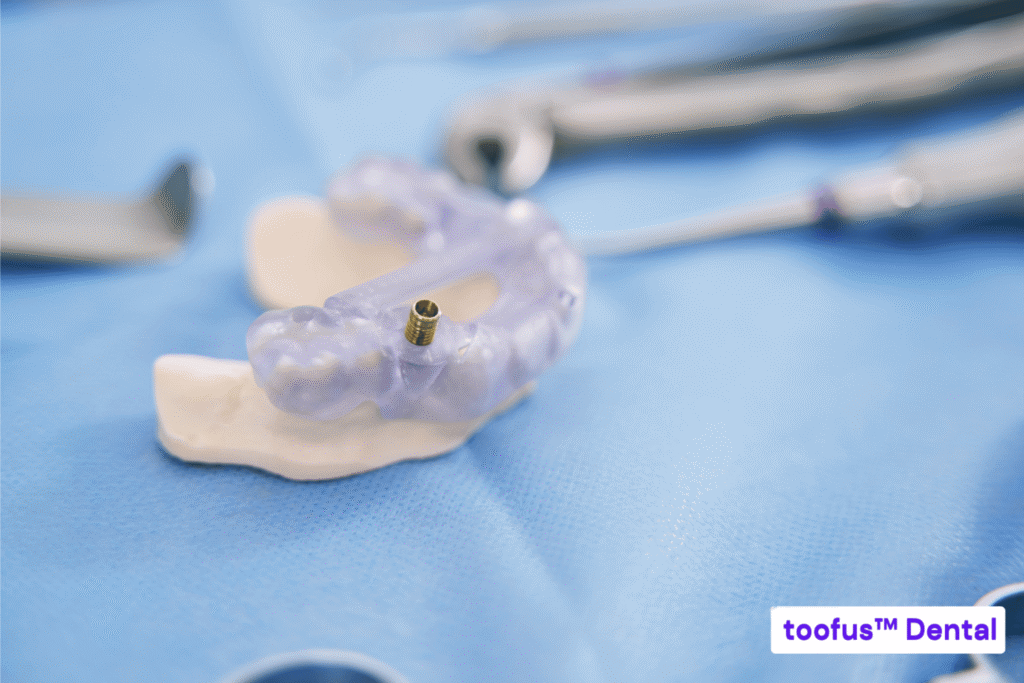
Using a surgical guide means doing dental implants without opening an entire flap (your gums). As a result, it allows for more precision and a reduction in recovery time.
Adjustment of dentures around your implants
On the same day as your implant surgery, your existing temporary dentures will be adjusted. If you have opted for temporary teeth to be attached to your implants, these will be adjusted and placed on your implants.
This lets you leave the clinic with a functional set of teeth, even while the implants are still fusing to the bone underneath through a process called osseointegration, which takes several months (3 – 4 months) to complete.
What Sedation Options Are Available in Singapore?
Depending on your anxiety levels, general budget and medical condition, you might be offered any one of the following sedation options for your All-on-x dental implant surgery.
| Sedation Type | What It Involves | Best Suited For |
| Local Anaesthesia Only | Numbing injections at the implant site. You are fully conscious. | Patients with low anxiety. Fewer implants being placed. |
| Oral Sedation | Sedative taken orally. Drowsy but responsive. | Patients with moderate anxiety and who are undergoing longer procedures. |
| IV Sedation | Sedative taken via an IV line. Administered by an anaesthetist. | Patients with a high level of anxiety and who are undergoing longer procedures. |
| General Anaesthesia | Fully unconscious and administered by an anaesthetist. | Patients who have to undergo complex dental treatment and have severe dental anxieties. |
How Can You Reduce Discomfort After Surgery?

If you have just completed your All-on-X dental implant surgery, the following tips and tricks can help reduce discomfort and aid with your recovery:
- Bite down on the gauze pack firmly for the first hour to control bleeding
- Swap out your gauze pack every hour
- Stick to cold and soft foods for the first 48 hours
- Do not eat fried, oily or spicy foods for at least 48 hours
- Do not bite on your surgical sites for at least a month, as this can reopen the wound
- Do not use a straw to drink as the suction can cause the blood clot to dislodge and re-open the surgical wound
- Use an ice pack to ice the outside of your jaw to prevent swelling and reduce discomfort
- Take prescribed painkillers on schedule rather than waiting until pain builds up
- Avoid rinsing vigorously or spitting hard for the first 24 hours
- Use gentle saltwater rinses only after 24 hours
- Do not move your dentures or bite down too hard on your temporary teeth for at least 2 weeks after surgery
Upper Arch vs Lower Arch Implants: Which Hurts More?
Based on anecdotes from our patients, lower arch implants tend to involve less swelling and tenderness post-surgery as compared to upper arch implants. I notice the same myself when treating patients for full arch dental implants.
Part of it comes down to bone density. The mandible is generally denser than the maxilla. Another reason might also be because the upper jaw sits closer to the sinus cavities, which can add a layer of pressure or congestion-like discomfort.
However, whether you are doing your implants on your lower or upper jaw, you should not be able to experience pain during the procedure.
When should I contact my dentist?
It is normal to experience soreness after the implant surgery. The soreness feels worse on Day 2 or Day 3 and should improve with time.
You should contact your dental implant dentist if you experience the following:
- Sharp and consistent pain from the surgical site
- Increasing pain after day 4 or day 5 of the implant surgery
- Pus that is coming out of the surgical site
- A bad taste that will not go away even after 7 days
- Gum tissue that looks inflamed and not just bruised
- An implant that feels loose
If you experience any of the above, it might not be usual surgical discomfort and can be tied to an infection or improper osseointegration of the implant. In these cases, you should definitely drop a call to your implant dentist instead of waiting and seeing.
Further Questions About Dental Implant Surgery Discomfort
Does All-on-X dental implant surgery hurt more than traditional dentures?
No, they do not. The discomfort from All-on-X dental implant surgery is also different from that of traditional dentures. It would be like comparing apples to oranges.
Traditional dentures do not require surgery at all. However, because it is shaped to fit onto the gums, there might be some long-term discomfort from the pressure of placing dentures on the gums for eating/biting.
Dentures can also cause sore spots from friction and slipping or from constant application of adhesives to the gums and dentures.
All-on-X dental implant surgery, on the other hand, tends to be more comfortable on a day-to-day basis since the prosthesis is anchored on the implants rather than resting on gums. Most of the discomfort is only experienced immediately post-surgery and for a week during the recovery process.
How long do I have to wait before I can eat normal hard foods again?
You will have to be on a soft food diet for the first one to two weeks.
Most patients ease back into a fairly normal diet by week three or four.
Though very hard or chewy foods sometimes get held off longer while the implants continue fusing to the jawbone underneath.
Can my dental anxiety worsen the pain that I feel?
Yes, that is actually possible. Pain perception is usually not just physical. It can be a result of how intensely people register discomfort.
What might be a simple, pain-free experience for a patient can be largely disturbing for another.
This is why sedation dentistry options exist beyond just numbing the surgical site.
Patients who go in dreading the experience often report rougher recoveries than those who feel informed and calm going into it, even when the surgery itself was identical.