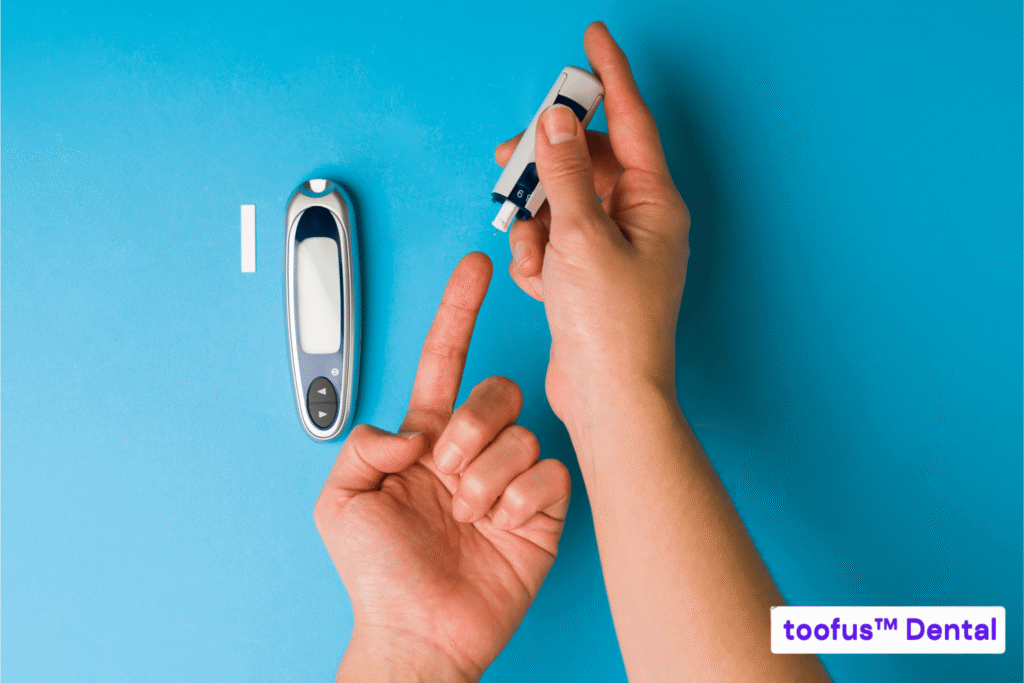
Having diabetes does not automatically mean that you are unsuitable for All-on-X dental implants.
Many people with well-managed diabetes can receive dental implants successfully. However, diabetes can affect gum health, wound healing and the way the jawbone integrates with dental implants.
Your suitability should therefore be assessed according to your overall health, recent blood sugar control, gum condition, available bone and ability to maintain the implants after treatment.
You may be suitable for All-on-X dental implants if your diabetes is reasonably controlled and the other risk factors affecting implant treatment have been properly managed.
Diabetes is generally regarded as a risk factor that requires additional planning. It is not an automatic reason to reject someone for dental implant treatment.
| Quick Summary |
|---|
| ▶ Having diabetes does not automatically rule you out from All-on-X dental implants. ▶ Well-controlled diabetes can allow for successful dental implant treatment. ▶ Poor blood sugar control may increase the risk of slower healing, infection and bone loss. ▶ Your HbA1c, gum health, bone condition and medical history should be assessed before implant surgery. ▶ All-on-X treatment may be delayed if your diabetes or oral health needs better control first. |
Table of Contents
- What Are All-on-X Dental Implants?
- Does Diabetes Rule You Out of Full-Arch Dental Implants?
- Why Does Diabetes Matter for Dental Implant Treatment?
- What HbA1c Level Is Needed for All-on-X Dental Implants?
- Can People With Type 1 Diabetes Have All-on-X Dental Implants?
- Does Diabetes Mean You Need Six Implants Instead of Four?
- Can People With Diabetes Receive Same-Day Fixed Teeth?
- Are Success Rates the Same as for People Without Diabetes?
- What Should Be Assessed Before All-on-X Surgery?
- What Should You Know About Fasting, Sedation and Diabetes Medication?
- How Can You Protect Your All-on-X Implants After Surgery?
- When Should All-on-X Treatment Be Delayed?
- What Warning Signs Should You Report After Surgery?
- Further Questions About Diabetes and Dental Implants
What Are All-on-X Dental Implants?
All-on-X dental implants replace a complete upper or lower arch of teeth with a fixed dental bridge supported by multiple dental implants.
Depending on your bone, bite and treatment plan, the bridge is usually supported by four to six dental implants. The number of implants should not be selected according to diabetes alone. It is determined by factors such as:
- The amount and quality of available jawbone
- The position and angulation of the implants
- The length of the dental arch
- Your bite force
- Whether you grind or clench your teeth
- Whether the upper or lower jaw is being restored
- The type of final bridge planned
- Whether any implants require additional protection or redundancy
For suitable patients, a provisional fixed bridge may be placed on the same day as implant surgery. This is commonly described as “teeth in a day” or immediate loading.
However, same-day fixed teeth are not guaranteed.
The implants must achieve sufficient initial stability before they can safely support a provisional bridge.
Does Diabetes Rule You Out of Full-Arch Dental Implants?
No. Diabetes alone does not automatically rule you out.
Research suggests that people with well-controlled diabetes can have favourable dental implant outcomes.
A systematic review of clinical studies concluded that implant treatment can be performed in people with diabetes when appropriate precautions are taken, and metabolic control is reasonably stable.
However, implant treatment becomes less predictable when diabetes is poorly controlled, particularly when it is combined with other risk factors such as:
- Active or untreated gum disease
- Smoking or vaping
- Poor oral hygiene
- Significant bone loss
- Previous dental implant failure
- Uncontrolled high blood pressure
- Kidney or cardiovascular complications
- Medications that affect healing or bone metabolism
- Difficulty attending regular maintenance appointments
Before you visit our dental implant dentists, let our patient success team know if you have any medical conditions, so that they can pre-inform our clinical team on how best to manage treatment planning.
Why Does Diabetes Matter for Dental Implant Treatment?
Dental implants depend on several biological processes. The gums must heal around the surgical sites, while the jawbone must form a stable connection with the implant surfaces. This process is called osseointegration.
Persistently high blood sugar can interfere with these processes in several ways.
Slower Wound Healing
Poorly controlled diabetes may impair blood circulation and the body’s immune response. This can slow the repair of gum and bone tissue following surgery.
Slower healing does not necessarily mean that the implants will fail. However, it may mean that your dentist recommends:
- A more conservative surgical plan
- A longer healing period
- Delayed placement of the final bridge
- Additional post-operative reviews
- More careful control of the forces placed on the implants
Greater Risk of Infection
Higher blood glucose levels can reduce the body’s ability to respond effectively to infection. This is particularly relevant when multiple teeth are extracted, and several dental implants are placed during the same appointment.
Any infection around a healing implant can interfere with osseointegration. For this reason, existing oral infections, uncontrolled gum disease and poor plaque control should be addressed as part of treatment planning.
Changes in Bone Healing
Diabetes can affect bone turnover and the activity of the cells responsible for forming new bone.
This does not mean that people with diabetes cannot form bone around dental implants. It means that bone integration may occur more slowly or less predictably when blood sugar remains poorly controlled.
Greater Risk of Gum Disease and Peri-Implantitis
People with diabetes are more susceptible to periodontitis, particularly when blood glucose is not well controlled.
Periodontitis affects the tissues supporting natural teeth. A related condition called peri-implantitis can affect the gums and bone surrounding dental implants.
A 2024 systematic review and meta-analysis found that poorer glycaemic control was associated with less favourable conditions around dental implants, including greater crestal bone loss. The study also found that well-controlled Type 2 diabetes was not, by itself, a risk indicator for peri-implant disease.
The relationship between diabetes and gum disease also works in both directions. Diabetes can make gum inflammation more difficult to control, while periodontal inflammation may make glycaemic management more difficult. A Cochrane review found moderate-certainty evidence that treating periodontitis can produce a meaningful improvement in HbA1c among people who have both diabetes and gum disease.
What HbA1c Level Is Needed for All-on-X Dental Implants?
HbA1c provides an estimate of your average blood glucose control over approximately the previous three months.
There is no universally accepted HbA1c cut-off that guarantees dental implant success or automatically makes someone unsuitable. HbA1c is one part of the assessment and should not be interpreted in isolation.
Singapore’s HealthHub lists an HbA1c of 7% or below as a general treatment target for many people with diabetes, while also emphasising that individual targets may vary. The American Diabetes Association’s 2026 guidance recommends aiming for an HbA1c below 8% within three months of elective surgery where possible.
These figures provide useful clinical guidance, but they are not absolute rules for every All-on-X patient.
| Recent HbA1c | What It May Mean for Treatment Planning |
| 7% or below | Generally indicates better glycaemic control. Treatment may proceed if your gums, bone and overall health are suitable. |
| 7.1% to 8% | Does not automatically prevent implant treatment. Your dentist may request medical input, review glucose stability and use a more cautious healing or loading protocol. |
| Above 8% | May indicate a greater risk of delayed healing, infection or long-term bone loss. Elective implant surgery may be postponed while control is improved. |
| Rapidly changing or unstable readings | Further medical assessment may be needed even if one HbA1c result appears acceptable. |
A single HbA1c reading also does not reveal everything. Your dentist may need to understand:
- Whether your glucose readings fluctuate significantly
- Whether you experience frequent hypoglycaemia
- Whether you have recently changed medication
- Whether you have diabetic kidney, eye, nerve or cardiovascular complications
- Whether you have recently been hospitalised
- Whether you have had previous problems with wound healing
- Whether your diabetes care team considers your condition stable
If your HbA1c is above the preferred range, this usually means “not yet” rather than “never.”
Improving glycaemic control before elective implant surgery may make treatment safer and more predictable.
Can People With Type 1 Diabetes Have All-on-X Dental Implants?
People with either Type 1 or Type 2 diabetes may be considered for dental implants.
However, most available dental implant research involves people with Type 2 diabetes. The evidence for Type 1 diabetes is less extensive, so it would be inaccurate to assume that both groups have exactly the same risk profile.
For a person with Type 1 diabetes, the dentist may pay particular attention to:
- Recent HbA1c
- Glucose variability
- Frequency of hypoglycaemic episodes
- Insulin requirements
- History of diabetic ketoacidosis
- Other diabetes-related complications
- The medical plan for fasting, sedation and surgery day
The type of diabetes matters, but it should not be considered without looking at how stable and well-managed the condition is.
Does Diabetes Mean You Need Six Implants Instead of Four?
Not necessarily.
The number of implants should be based on the biomechanics of the restoration, not on a rule that everyone with diabetes requires additional implants.
Using six implants may provide greater support or redundancy in some full-arch cases. However, placing more implants also means creating more surgical sites. If the bone is limited or the patient has a higher surgical risk, more implants are not automatically better.
During your consultation with our dental implant dentists, we will explain why four, five or six implants are being recommended and how the proposed design affects:
- Load distribution
- Cleaning access
- Repairability
- Future maintenance
- Bone requirements
- Treatment cost
- The consequences if one implant does not integrate
Can People With Diabetes Receive Same-Day Fixed Teeth?
Possibly, but immediate loading should be decided during treatment planning and confirmed at the time of surgery.
The decision depends on whether the implants achieve sufficient primary stability when they are placed. Other considerations include:
- Bone density and volume
- Implant position and angulation
- The number of implants used
- The design of the provisional bridge
- The amount of force placed on the bridge
- Grinding or clenching habits
- Active infection
- Smoking
- Overall healing capacity
- Ability to follow a strict soft-diet protocol
A clinical study involving immediately loaded implants in people with controlled Type 2 diabetes reported favourable outcomes.
Nevertheless, the evidence is not strong enough to conclude that immediate loading is suitable for every diabetic patient.
If primary stability is inadequate, delaying the fixed bridge is usually the safer decision. A temporary removable denture may be provided while the implants heal.
Are Success Rates the Same as for People Without Diabetes?
People with well-controlled diabetes can achieve high implant survival rates. However, this should not be used as a blanket fact for every diabetic patient.
Most studies combine different types of dental implant treatment, including single implants, short bridges and removable implant restorations. There is less research examining All-on-X treatment exclusively in people with diabetes.
Studies also use different definitions of:
- Controlled and uncontrolled diabetes
- Implant survival
- Implant success
- Peri-implantitis
- Marginal bone loss
- Follow-up duration
For these reasons, it would be misleading to promise one specific All-on-X success rate for every patient with diabetes.
The most balanced interpretation of the current evidence is:
- Well-controlled diabetes is not an absolute contraindication to dental implants.
- Many patients with controlled diabetes experience successful implant integration.
- Poor glycaemic control is associated with greater concern about delayed healing, peri-implant inflammation and bone loss.
- Long-term maintenance is particularly important because some complications may only become apparent several years after treatment.
Implant survival also does not mean that the entire restoration remains maintenance-free. The bridge, screws and other prosthetic components can still require adjustment, repair or replacement even when the implants remain integrated.
What Should Be Assessed Before All-on-X Surgery?

A proper assessment should examine both your mouth and your general health.
Recent HbA1c and Medical History
Bring a recent HbA1c result, preferably from within the previous three months.
Your dentist should also review:
- Your diabetes medication
- Insulin use
- Blood pressure
- Kidney and cardiovascular health
- Previous surgeries and healing problems
- History of hypoglycaemia
- Allergies
- Smoking and vaping
- Anticoagulants or antiplatelet medication
- Steroids, osteoporosis medication or immunosuppressants
Do not stop or change any prescribed medication unless the prescribing doctor and treating dental team have given you specific instructions.
Gum and Infection Assessment
Your dentist should examine the gums, remaining teeth and areas of active infection.
This may involve:
- Periodontal charting
- Dental X-rays
- Professional cleaning
- Deep gum cleaning or root planing
- Removal of teeth that cannot be predictably saved
- Reassessment of bleeding and gum inflammation
Treating gum disease does more than prepare the mouth for implants. Evidence suggests that periodontal treatment may also support better glycaemic control in people with diabetes and periodontitis.
Bone and Three-Dimensional Assessment
An OPG X-ray provides an overview of the teeth and jaws. A CBCT scan provides three-dimensional information about the available bone and nearby anatomical structures.
The assessment helps determine:
- Whether there is sufficient bone
- Where the implants can be placed
- Whether guided implant surgery may be appropriate
- Whether bone grafting is required
- Whether posterior implants can be angled safely
- Whether four or six implants may provide a more suitable foundation
All-on-X treatment can sometimes reduce the need for extensive bone grafting by using available bone more efficiently. However, it does not guarantee that bone grafting or other preparatory procedures can always be avoided.
Medical Coordination
Your dentist may contact your GP, endocrinologist or other treating specialist if:
- Your glucose control is unstable
- Your HbA1c is above the preferred range
- You experience frequent hypoglycaemia
- You have diabetes-related complications
- Sedation is being considered
- Your medication needs to be adjusted around surgery
Medical clearance should not be treated as a formality. It allows the dental and medical teams to agree on a safer plan for fasting, medication, glucose monitoring and post-operative care.
What Should You Know About Fasting, Sedation and Diabetes Medication?
Most dental implant procedures performed under local anaesthesia do not require prolonged fasting. Intravenous sedation or general anaesthesia may require fasting according to the sedation provider’s instructions.
Fasting can complicate diabetes management, especially for people taking insulin or medications that can cause hypoglycaemia.
Before surgery, ask:
- Do I need to fast?
- What time should I stop eating and drinking?
- Which medications should I take on the day of surgery?
- Does my insulin dose need to be adjusted?
- How will my glucose be monitored?
- What happens if my glucose becomes too low or too high?
- When can I eat after the procedure?
- Should I bring my glucose meter or continuous glucose monitor?
- Should I bring hypoglycaemia treatment with me?
Do not independently skip insulin, metformin or any other diabetes medication based on general online advice. The correct plan depends on the medication, the type of anaesthesia, the length of the procedure and your personal risk of hypoglycaemia or hyperglycaemia.
Morning appointments may be preferable for some patients because they can reduce disruption to meals and medication schedules, but this should be coordinated individually.
How Can You Protect Your All-on-X Implants After Surgery?
The long-term outcome depends on more than what happens during surgery.
Maintain Stable Blood Glucose
Continue following the diabetes management plan provided by your healthcare team. Contact your doctor if illness, reduced food intake, or post-operative medication causes unexpected changes in your glucose readings.
Follow the Recommended Diet

A soft diet is commonly required while the implants integrate.
Choose foods that are soft but nutritionally balanced, such as:
- Eggs
- Soft fish
- Tofu
- Unsweetened yoghurt
- Soft vegetables
- Soup with suitable protein
- Minced or slow-cooked meat
- Low-sugar nutritional supplements where appropriate
Avoid relying mainly on sweet drinks, ice cream or refined carbohydrates during healing.
Clean Under the Bridge
A fixed full-arch bridge still needs daily cleaning.
Your dental team may recommend:
- A water flosser
- Interdental brushes
- Super floss or implant floss
- A soft toothbrush
- A specific bridge-cleaning technique
- Professionally recommended mouth rinses for a limited period
Your final bridge should be designed with enough access for you or your caregiver to clean underneath it.
Attend Regular Maintenance
People with diabetes may benefit from closer implant maintenance, particularly if they have a history of gum disease.
Your dentist may recommend reviews every three to six months depending on your risk profile. Maintenance appointments may include:
- Assessment for bleeding or inflammation
- Cleaning around and underneath the bridge
- Measurement of gum pocket depths
- Review of your bite
- Checking bridge screws and prosthetic components
- X-rays when clinically required
- Reinforcement of home-cleaning techniques
When Should All-on-X Treatment Be Delayed?
Treatment may need to be postponed if you have:
- Persistently poor or unstable glycaemic control
- A recent diabetic emergency
- Active, untreated oral infection
- Uncontrolled gum disease
- Frequent unexplained hypoglycaemia
- Uncontrolled high blood pressure
- A recent heart attack, stroke or major cardiovascular event
- An unresolved medication concern
- A current illness affecting your ability to heal
- An inability to maintain oral hygiene or attend follow-up appointments
Delaying treatment does not necessarily mean that All-on-X will never be possible. It may mean that your health and oral condition need to be stabilised before surgery.
It is not a good idea to rush your dentist or oral surgeon into doing implant surgery for you when you are medically compromised. Doing so can lead to implant failure.
An ethical dentist/oral surgeon would not rush implant surgery if they are aware of your uncontrolled diabetes.
What Warning Signs Should You Report After Surgery?
Some discomfort and swelling are expected after full-arch implant surgery. Contact your dentist promptly if you experience:
- Swelling that continues to worsen
- Persistent or increasing pain
- Pus or discharge
- A persistent unpleasant taste or smell
- Fever or feeling significantly unwell
- Bleeding that does not settle
- The provisional bridge becoming loose
- A change in your bite
- Difficulty controlling your blood glucose
- Symptoms of hypoglycaemia or hyperglycaemia
Do not wait until your scheduled review if something does not feel right.
Further Questions About Diabetes and Dental Implants
Will my dentist need to speak to my primary care doctor before implant surgery?
Not every patient requires formal medical clearance.
However, communication with your GP or endocrinologist may be appropriate if your diabetes is unstable, your HbA1c is elevated, you have diabetes-related complications or medication adjustments may be required.
Will healing take longer if I have diabetes?
It can. Poor glycaemic control may delay soft-tissue and bone healing.
Some well-controlled patients heal within the usual timeframe, while others benefit from a longer healing period before receiving the final bridge.
Will I automatically need antibiotics post-surgery?
Your dentist will determine whether antibiotics or other antimicrobial measures are appropriate based on the extent of surgery, infection risk, medical history and current clinical guidance.
It is normal to take a course of antibiotics post-implant surgery to control risk of infection. However, antibiotics should not be prescribed automatically or taken without professional advice.
Can I have my All-on-X dental implants surgery if my HbA1c is above 8%?
Possibly, but elective implant surgery may be postponed while your diabetes management is reviewed.
An HbA1c above 8% is not a permanent rejection. It signals that the potential benefits of immediate treatment should be weighed carefully against the increased healing and infection concerns.
Can All-on-x dental implants help me to eat better and manage my diabetes?
Replacing unstable or missing teeth may make it easier to eat a wider variety of foods, including vegetables and protein sources that can be difficult to chew with loose dentures.
However, All-on-X treatment does not directly treat diabetes.
Any improvement in nutrition or glycaemic control will still depend on your food choices, medical treatment and overall lifestyle.
Are overdentures (implant-supported dentures) safer for people with diabetes than All-on-X dental implants?
Not automatically.
Overdentures may use fewer implants and may be easier to remove for cleaning.
All-on-X provides a fixed bridge and may offer greater stability.
Each treatment has different surgical, maintenance, functional and financial considerations.
The more suitable option depends on your bone, gum health, dexterity, cleaning ability, medical risk and personal priorities.
Can People With Diabetes Have All-on-X Dental Implants?
Yes, many can.
The safest answer is not an unconditional “yes” or a blanket “no.” Diabetes should be considered as part of a complete risk assessment.
A suitable treatment plan should take into account:
- Your recent HbA1c and glucose stability
- Your gum and bone health
- Any active infection
- Your medical complications and medication
- Smoking or vaping
- The proposed number and position of implants
- Whether immediate loading is appropriate
- Your ability to clean and maintain the final bridge
At toofus™ Dental, we work with patients who often have complex medical conditions and histories. We believe that patients should receive a clear explanation of their risks, alternatives, treatment timeline and long-term maintenance requirements before proceeding with full-arch dental implant treatment.
Sometimes the right answer is to proceed. Other times, it is to modify the treatment plan, improve your health first and return to implant treatment later.
The goal is not to place implants as quickly as possible but to build a restoration that can be maintained safely and predictably for as long as possible.